
Dryer Not Heating? Start With Gas or Electric
The drum turns, the clothes stay cold. The likely parts are different for gas and electric dryers, and a blown thermal fuse almost always has a cause behind it.
By Daniil, owner and lead technician · Updated · Rated on Google from 109 reviews
First: gas or electric?
An electric dryer plugs into a large 240-volt outlet and has no gas line. A gas dryer plugs into a normal outlet and has a gas line with a shut-off valve behind it. Everything below depends on which you have.
Electric dryer: what to check
- The breaker. Electric dryers use a double breaker. If one half trips, the motor and controls can still run while the heating element gets no power. Switch the dryer’s breaker fully off, then on again.
- The setting. Make sure it isn’t on Air Fluff or a no-heat cycle.
- The vent. Run the dryer and feel the airflow outside. Weak airflow is the reason a thermal fuse or high-limit thermostat trips (see dryer takes too long to dry).
Beyond that, the parts need a meter: thermal fuse (one-time; opens if the dryer overheats), heating element (a coil that can break or short to the housing), high-limit thermostat and cycling thermostat (they can open early or stick), and on some models the control board relay that feeds the element.
Gas dryer: what to check
- Gas supply. Is the valve behind the dryer fully open? Are other gas appliances working?
- Watch the igniter through the small window or opening at the burner (some models need the lower front panel removed; if you aren’t comfortable, leave it). An igniter that never glows points to the igniter or the flame sensor. An igniter that glows, then goes dark without a flame, points to the gas valve coils. A flame that lights and then goes out after a few minutes, with no heat later in the cycle, is also a classic coil symptom.
If you smell gas, turn the dryer off, leave the house and call PG&E from outside before calling anyone else.
What each symptom points to
| What you notice | Electric dryer | Gas dryer |
|---|---|---|
| Tumbles, no heat at all | Breaker half tripped; thermal fuse; element; high-limit thermostat | Igniter; flame sensor; thermal fuse |
| Heats briefly, then cold | Cycling or high-limit thermostat tripping from poor airflow | Gas valve coils; flame sensor |
| Some heat, takes forever | Restricted vent; one failing thermostat | Restricted vent; weak coils |
| Won’t start at all (no tumble) | Door switch, thermal fuse on many models, belt switch, motor | Same |
| Burning smell | Stop using it until it has been checked. Lint in the blower housing or near the heater is a fire risk | |
Why the thermal fuse is a symptom, not the cause
The thermal fuse is there to cut the heat if the dryer overheats. Dryers overheat when the hot, moist air can’t leave: lint in the vent run, a crushed duct behind the dryer, or lint packed in the blower housing. If the fuse has blown, something made the dryer overheat, and replacing the fuse without finding the restriction just sets up the next failure. The U.S. Fire Administration found that failure to clean was the leading factor in residential clothes dryer fires.


What we check on a no-heat call
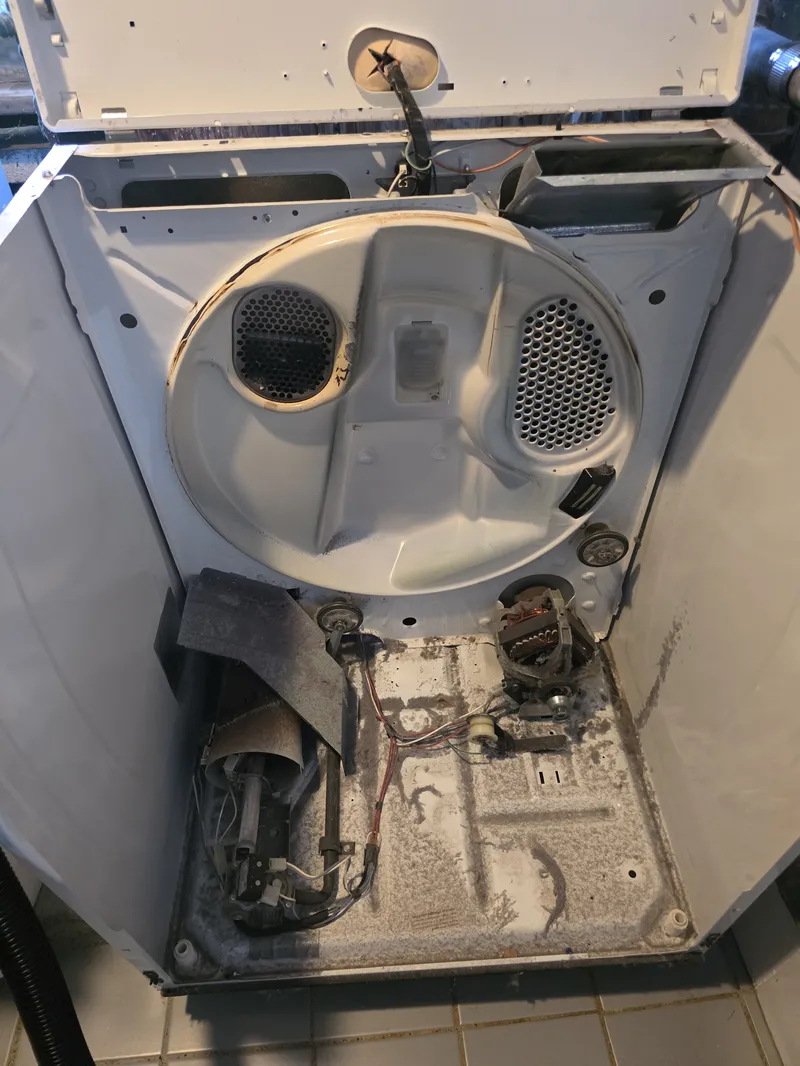
Dryers are quick to diagnose with a meter: heat circuit, airflow or drive. On an electric dryer we test the heating element, thermal fuse, high-limit and cycling thermostats. On a gas dryer we watch the igniter and check the flame sensor and gas valve coils. Then we check the exhaust, because a restricted vent is both the most common reason a fuse blows and the most common reason a dryer that does heat still takes forever. We check the blower housing and vent on every no-heat or slow-dry call, clear the lint we can reach, and tell you if the vent itself needs cleaning or rerouting; long roof or wall runs may need a vent-cleaning company.
Repair or replace?
Belts, rollers, idler pulleys, thermal fuses, thermostats, igniters and heating elements are inexpensive and usually quick, so a no-heat dryer is almost always worth repairing. Replacing a drum or motor on an older budget dryer is a closer call; we will give you the price and our opinion.
Dryer repair in Marin County and San Francisco
UniFix repairs gas and electric dryers, stacked and standalone, across Marin County from San Rafael and in San Francisco from our Marina location. Diagnostic visits start at $85; the fee varies by appliance type, brand, location and appointment requirements, is confirmed before scheduling, and is applied toward the repair if you go ahead. Repairs carry a written warranty on parts and labor; the term is stated on your invoice. More on our dryer repair page.
Call Marin (415) 494-7882 or San Francisco (415) 683-0403. Tell us gas or electric, the model number (usually on a label inside the door frame or on the back panel) and where the vent goes.
Common questions
Is a dryer that is not heating dangerous to keep using?
Why does my electric dryer tumble but not heat?
My gas dryer heats for a few minutes and then stops. Why?
Can I just replace the thermal fuse?
Do you work on gas dryers?
Sources
Request a visit
Prefer to talk? Call (415) 494-7882 (San Francisco: (415) 683-0403). UniFix Appliance Repair diagnostic visits start at $85. The diagnostic fee varies by appliance type, brand, location, and appointment requirements. We confirm the fee before scheduling. If you approve the repair, the diagnostic fee is applied toward it.