
Sub-Zero Refrigerator Not Cooling: What to Check and What It Usually Means
The owner checks worth doing first, the temperature that tells you whether a condenser cleaning can still fix it, and what a technician looks for when it can’t.
By Daniil, owner and lead technician · Updated · Rated on Google from 107 reviews
Check these first (10 minutes, no tools)
These are the checks Sub-Zero itself lists before calling service, in the order we would do them on the phone with you:
- Setpoint. Electronic controls: 38°F for the refrigerator and 0° for the freezer. Older dial controls (200, 300 and 500 Series): between 4 and 6, where 1 is warmest and 10 is coldest. After any change, give it 24 hours.
- Door and gasket. Make sure nothing (a pan handle, a crisper, a drawer that was pushed back crooked) stops the door from closing fully, and look along the gasket for tears or flattened sections. Turn the door-ajar alarm on if it’s off.
- Sabbath and Showroom mode. If the display shows no temperatures or the panel doesn’t respond, Sabbath mode may be on. Showroom mode (lights on, no cooling) is meant for dealer displays, but it does turn up in homes.
- A disabled compartment. If the lights are off in one section and that section isn’t cooling while the other is, check that it hasn’t been switched off; a display showing double dashes means it may be disabled.
- Recent loading. A full shop or a pot of warm food raises temperatures for several hours. A freezer packed tight also cools worse, because the air can’t circulate.
- New installation. A newly installed or just-restarted unit needs at least 24 hours to reach temperature.
The temperature that decides your next step
Put an appliance thermometer in a glass of water in the middle of the compartment and read it after a few hours with the door closed. The door display and how hard the ice cream feels are not reliable. Then compare:
| Reading | What it means | What to do |
|---|---|---|
| Refrigerator 40°F or below, freezer around 0° | Within normal range | Recheck the setpoint; nothing else needed |
| Refrigerator above 40°F but under 48°F; freezer less than 10° above setpoint | Running warm; often airflow at the condenser | Clean the condenser (below), wait 24 hours, recheck |
| Refrigerator above 48°F at a 38°F setpoint | Sub-Zero: unlikely to recover from condenser cleaning alone | Book service; move perishables |
| Freezer more than 10° above a 0° setpoint | Sub-Zero: unlikely to recover from cleaning alone | Book service; move frozen food that matters to you |
For food safety the FDA guideline is 40°F or below for the refrigerator and 0°F for the freezer. Sub-Zero’s own guidance is that food is not safe above 45°F.
Which side is warm tells you a lot
Many classic built-in Sub-Zero models run separate refrigeration systems for the refrigerator and the freezer, each with its own fans, evaporator and defrost. That is why one side can fail while the other stays cold, and why we always ask which side is warm, and since when, before we arrive.
| What you notice | Most likely area |
|---|---|
| Both sides slowly warmer; top grille area very dusty; the unit runs almost constantly | Condenser airflow: dirty condenser or a condenser fan that has stopped |
| One side warm, the other side normal | That side’s circuit: its evaporator fan, defrost, temperature sensor or, on dual-system models, its own sealed system |
| Frost or ice building on the back wall or evaporator cover; temperatures drifting up and down | Defrost system fault (heater, sensor or control). The ice blocks the air path, so the fans run but move little cold air |
| Fan noise changes, or no air moving from the vents in the warm section | Evaporator fan motor, or a fan blocked by ice |
| A service wrench or error message on the display | See the indicator table below; some point to a specific sensor |
| Clean condenser, fans running, no frost problem, still warm on an older unit | Possible sealed-system problem (compressor, leak or restriction). Needs testing, not guessing |
How to clean the condenser
On classic built-ins the condenser sits at the top, behind the grille above the doors; for other models, your use and care guide shows where it is. Sub-Zero recommends cleaning it if it hasn’t been done in the last 6 months (3 months if the freezer is the warm side). It isn’t needed on a unit less than 6 months old.
- Switch the unit off at its control or the circuit breaker.
- Remove the grille as described in your use and care guide.
- Vacuum the condenser fins with a soft brush attachment, working in the direction of the fins. Don’t bend them, and don’t probe around wiring or the fan blade.
- Refit the grille, switch the unit back on and give it 24 hours before judging the result.
If you can’t reach the grille safely, leave it for the service visit. A dirty condenser makes every other test less reliable, so it is one of the first things we check.
What the display is telling you
| Indicator | What Sub-Zero says it means | Owner action |
|---|---|---|
| “Vacuum Condenser” flashing (600 Series before serial 1810000) | The unit isn’t running efficiently or temperatures are too high: dirty condenser, door sealing problem or a unit problem | Switch off, clean the condenser, check the door, switch back on (this resets the message). If it returns and temperatures rise, book service |
| Wrench icon flashing with alarm chiming (Legacy Classic) | A major error code has been logged | If temperatures are fine, turn the breaker off for 30 seconds and back on, then watch it. If it returns, book service |
| “EE” with the service wrench flashing (Classic) | A failed temperature sensor (thermistor): left side = freezer, right side = refrigerator | No owner fix; book service and tell us which side showed it |
Before you call, photograph the display. Codes on some models only show for a few seconds, and knowing the code and the side lets us bring the right sensor or part on the first visit.
What we check on a Sub-Zero no-cool call
We confirm which compartment is affected and measure it, check the condenser and condenser fan at the grille, look at the evaporator for the frost pattern (an even light frost, a solid block of ice, or a bare coil each point somewhere different), and read the control’s diagnostics where the model supports it. The point of the first visit is to separate a same-visit repair (cleaning, a fan, a sensor, a valve) from a parts order or a sealed-system repair, and to give you the price before any work starts.
Most Sub-Zero parts are special-order. Diagnosing completely on the first visit means the right part is ordered once, and you know the lead time before you approve.
From our service calls
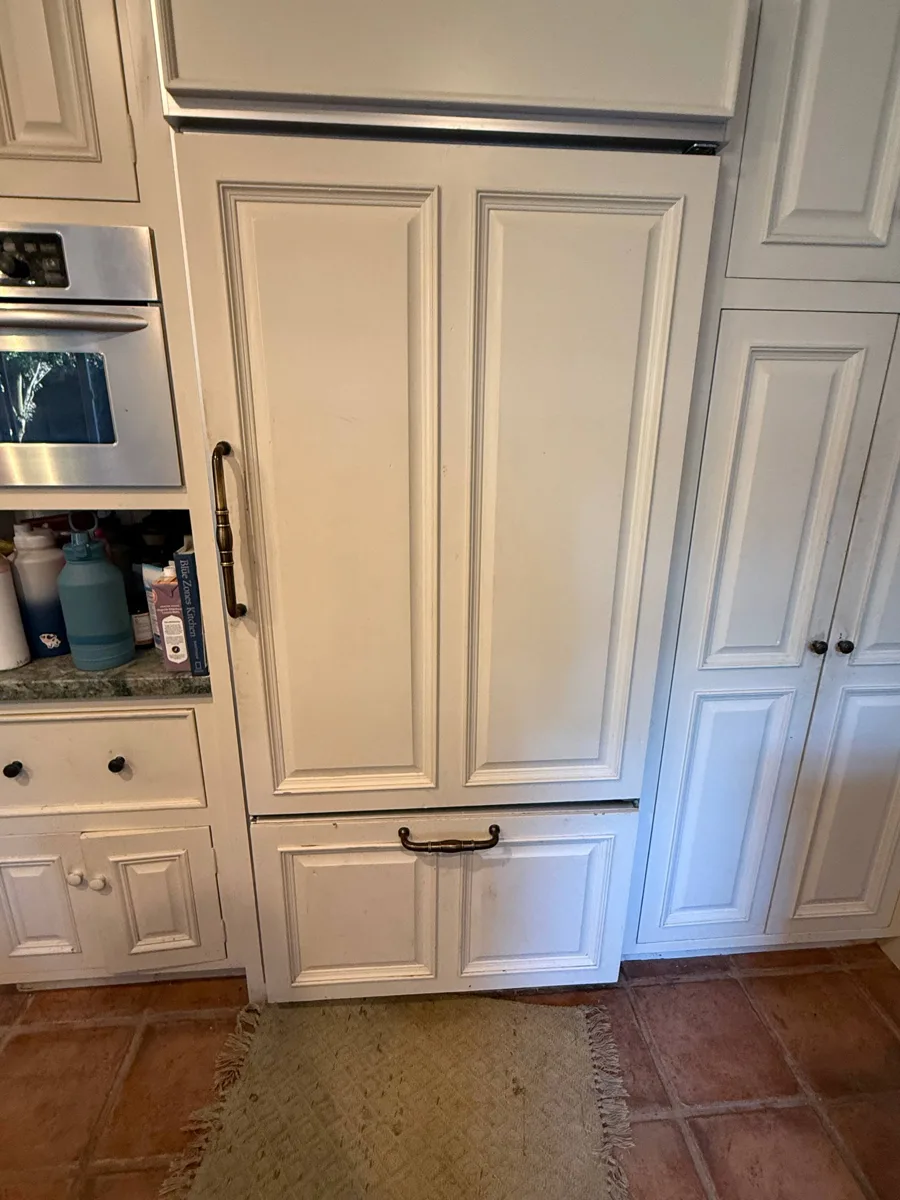


- Sausalito, August 2026. A built-in Sub-Zero with excessive ice in the refrigerator compartment and around the evaporator, restricted airflow and unstable temperatures. We traced it to the defrost system, replaced the defrost kit, cleared the ice and checked airflow, fans and cooling. Read the repair record.
- Sausalito, August 2026. The owner had spent two weeks and collected five estimates. We went out the same day and repaired the refrigerator on the first visit. Read the repair record.
- A 27-year-old built-in, September 2026. Stopped cooling; diagnosed the next morning, parts sourced, running by the following Tuesday. Read why it was worth repairing.
Repair or replace?
Sub-Zero refrigeration is built to be repaired, and a built-in fits a specific cabinet opening, so replacing one often means cabinetry work as well as the new unit. Fan, defrost, sensor, control and valve repairs are normally a clear win. A sealed-system repair is a bigger decision, and it deserves a real diagnosis and a written quote before anyone recommends replacement.
If the unit is still under Sub-Zero’s warranty, call Sub-Zero’s own Factory Certified Service first so the repair is covered.
Sub-Zero service in Marin County and San Francisco
UniFix diagnoses Sub-Zero built-in, integrated column, undercounter and wine storage units in place, across Marin County from San Rafael and in San Francisco from our Marina location. We see Sub-Zero most in Sausalito, Mill Valley, Tiburon and Belvedere and San Francisco. Diagnostic visits start at $85; the fee varies by appliance, brand, location and appointment requirements, is confirmed before scheduling, and is applied toward the repair if you go ahead. More on our Sub-Zero repair page and refrigerator repair page; for other brands, see refrigerator not cooling.
Call Marin (415) 494-7882 or San Francisco (415) 683-0403. Tell us the model, which side is warm, the temperature you measured and any code on the display.
Common questions
My Sub-Zero freezer is cold but the refrigerator is warm. What does that mean?
Will cleaning the condenser fix a warm Sub-Zero?
How long should a Sub-Zero take to cool after a fix or a restart?
Should I defrost the ice myself?
Is it safe to keep using a Sub-Zero that is running warm?
Sources
Request a visit
Prefer to talk? Call (415) 494-7882 (San Francisco: (415) 683-0403). UniFix Appliance Repair diagnostic visits start at $85. The diagnostic fee varies by appliance type, brand, location, and appointment requirements. We confirm the fee before scheduling. If you approve the repair, the diagnostic fee is applied toward it.